Settings
Sandbox, rate limit, default provider, tracking, and suppressions.
Settings is the per-application control surface. It is not a billing plan. The card says so on the page.
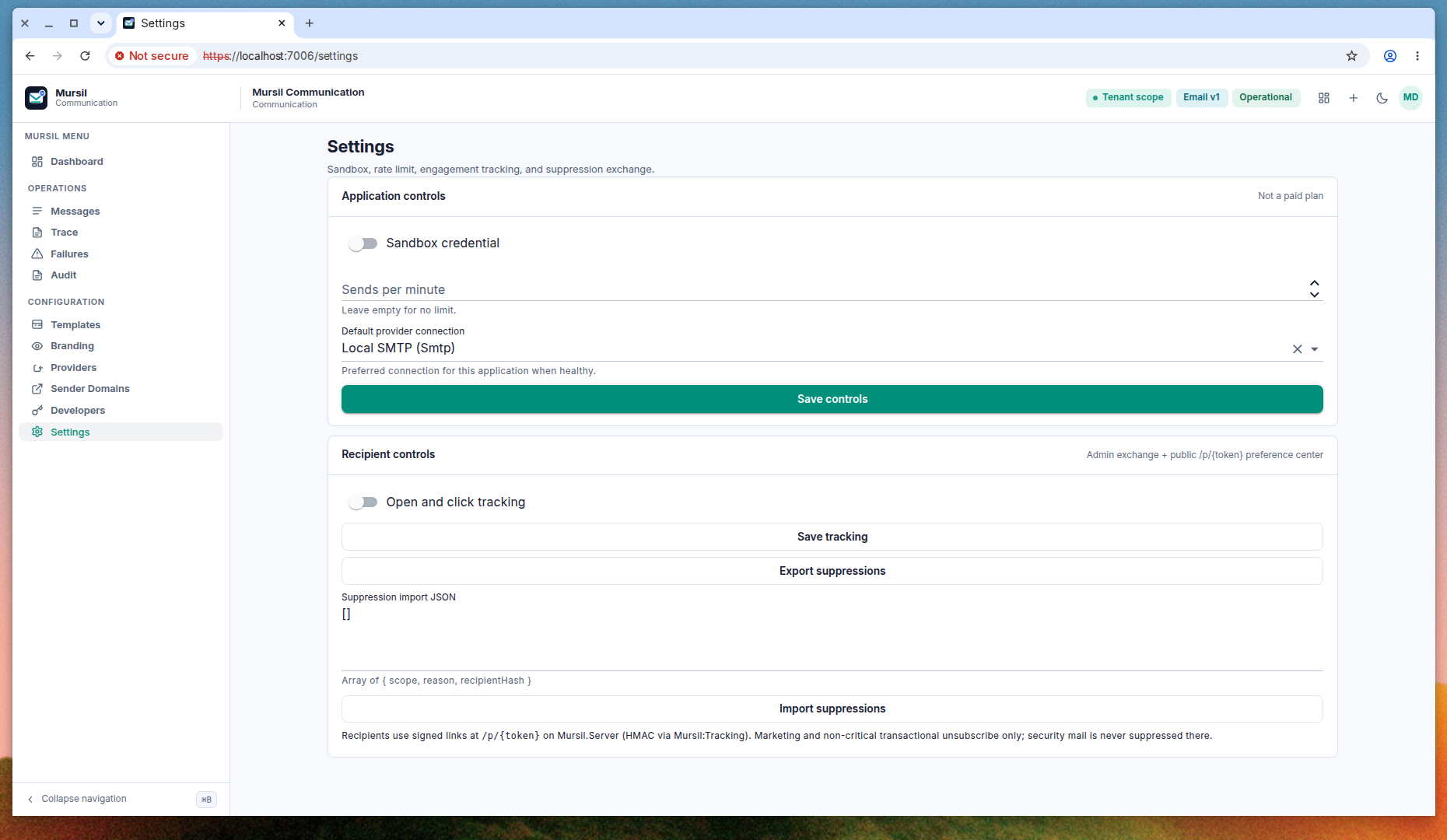
Application controls
| Control | Effect |
|---|---|
| Sandbox credential | Sends are accepted with state Sandbox and are not handed to the provider. |
| Sends per minute | A limit for the application. Leave the field empty for no limit. |
| Default provider connection | The connection used when a send does not name providerConnectionId and the connection is healthy. |
Save writes three API calls: sandbox, rate limit, and default provider. The provider list is the same list as Providers.
Recipient controls
Open and click tracking rewrites links and inserts an open pixel when it is on. The public endpoints are GET /t/o/{token} and GET /t/c/{token} on Mursil.Server. Tokens are signed. Set Mursil:Tracking:PublicBaseUrl to the public origin of the server, and set Mursil:Tracking:HmacSecret from your secret store, before you enable tracking on a shared deployment.
Export suppressions downloads the current suppression rows. Import suppressions accepts a JSON array of { "scope", "reason", "recipientHash" }. The hash is the stored recipient hash, not a raw address written into the portal.
Recipients manage their own marketing and non-critical preferences at GET /p/{token} and POST /p/{token}. The link is signed. Security mail is not suppressed there. One-click unsubscribe is POST /api/v1/mursil/preferences/one-click.
Who can open Settings
The page requires an operator role: SystemAdmin, TenantOwner, TenantAdmin, or Operator. Engagement tracking itself is an owner action on POST /api/v1/mursil/tenants/engagement-tracking.
Developers page
Developers is in the menu and is authorized for operators. The page does not yet store API credentials. Client ids and secrets stay in configuration, as described in Setup.